Special Equipment Consulting
Special equipment manufacturing license, that is TS (by the 特(Te), 设(She) Chinese Pinyin initials) Certification, is issued by the General Administration of Quality Supervision, Inspection and Quarantine. It is the approval of special equipment in production (including design, manufacturing, installation, transformation, maintenance and other projects), use, inspection and testing of units related to supervision, inspection, and other related units. The highest legal basis for the management of special equipment is the “Special Equipment Safety Supervision Regulations”.
Special equipment refers to eight types of equipment involving life safety and greater risk: boilers, pressure vessels (including gas cylinders), pressure pipelines, elevators, lifting machinery, passenger ropeways, large amusement facilities and special motor vehicles in field (factory). In order to ensure the safe operation of special equipment, China has strict regulations on all kinds of special equipment from the three links of production, use, inspection and testing, and implements supervision in whole process. On June 29, 2013, the Standing Committee of the 12th National People’s Congress passed the “Special Equipment Safety Law of the People’s Republic of China”. In November 2014, the General Administration of Quality Supervision, Inspection and Quarantine of the People’s Republic of China (AQSIQ for short) published the newly revised “Special Equipment Catalogue”.
“Special Equipment License”, also known as “Security Registration” (formerly “AZ Security Registration Approval”), is TS at present. Special equipment license is a mandatory safety supervision implemented by the state in order to prevent and reduce accidents, protect people’s lives and property safety, and promote economic development. Its role is equivalent to the “CE Certification” of EU, but the standard of “Special Equipment License” in China is more strict than that of “CE Certification”. “Special Equipment License” is directly managed by the AQSIQ.
Special Equipment Certification Scope
| TS Certification Scope |
| Manufacturing license for boiler and pressure vessel |
| Manufacturing license for pressure piping components |
| Manufacturing license for motor vehicles in the factory |
| Manufacturing license for passenger ropeway |
| License for large amusement facilities |
| Manufacturing license for large amusement facilities |
| Manufacturing license for lifting machinery |
| Manufacturing license for elevator special equipment |
Special Equipment Service Content
| Identify product certification scope |
| Review and revise quality manual |
| Review and revise application documents |
| Track application progress |
| Assist in the preparation of the preliminary audit |
| Coordinate factory audit |
| Document translation, factory audit interpretation services |
| Review export filing documents |
Contact Us
If you or your business is experiencing the following problems, please contact us:
- You are a manufacturer of pressure vessels or other special equipment and are going to export pressure vessels or boilers to China.
- You are not sure which category your product belongs to.
- You plan to export products to customers in China on a regular or one-time basis.
- You already have a relevant license but aren’t sure if it needs to be certified in light of regulatory changes.
- You would like to know the requirements of Chinese regulations.
- Your equipment is complex and is assembled from components produced by different companies.
Production and Licensing Process of Special Equipment
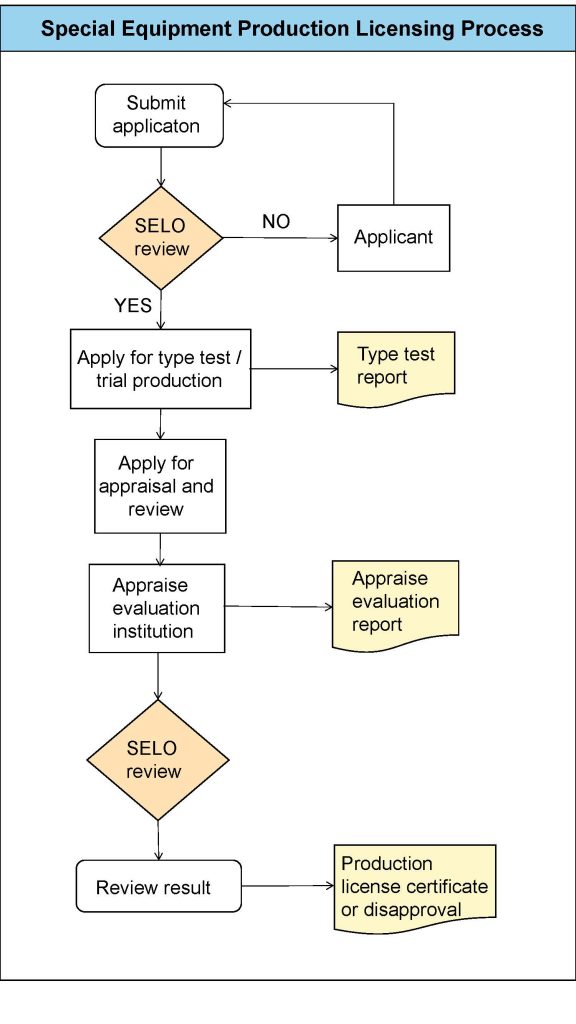
Requirements for Special Equipment Manufacturer License Production
The application requirement shall be in accordance with the “Rules of Special Equipment Production and Filling Manufacturer Licensing”.
The applicant shall have the following resources that are compatible with the scope of the license and meet the needs of production:
- Personnel, including management personnel, technical personnel, testing personnel, operators, etc.
- Workplace, including site, factory, office, warehouse, etc.
- Equipment and facilities, including production (filling) equipment, process equipment, testing instruments, test equipment, etc.
- Technical data, including related documents, process documents, construction plans, inspection procedures, etc.
- Regulatory standards, including laws, regulations, rules, safety technical specifications and related standards.
Specific resource requirements are listed in the Annex B to Annex L of the “Special Equipment Production and Filling Manufacturer Licensing Rules”.